Monsoon Car Care for SUVs in India: What Your Creta, Scorpio, Fortuner or XUV700 Needs This Rainy Season
India's car market crossed a milestone quietly a few years ago — SUVs and crossovers now outsell sedans and hatchbacks combined. The Hyundai Creta, Kia Seltos, Mahindra Scorpio, Tata Nexon, Toyota Fortuner, MG Hector, and Mahindra XUV700 are now among the most common vehicles on NCR and Dehradun roads. Most of their owners treat them the same way they would treat a sedan when it comes to monsoon care — which is the root of the problem. An SUV is not a bigger sedan. It has a panoramic roof that can leak into your headliner. It has running boards and roof rails that trap moisture against bare metal. It has a third row and boot section that most car washes never reach. It has a larger underbody exposed to highway splash. And it has a bonnet surface 30 to 40 percent larger than a sedan's — which means proportionally more acid rain exposure in every downpour. This guide covers every one of these SUV-specific risks and what to do about each one before the monsoon causes damage that is expensive to undo.
More than half of all SUVs sold in India over the last four years come with a sunroof or panoramic roof as standard or optional equipment — the Creta, Seltos, Hector, XUV700, and Nexon all offer it, and buyers choose it in large numbers. During the monsoon, this feature becomes the source of a problem that surprises first-time sunroof owners. It is not the glass itself that leaks — the rubber seals around modern sunroof panels are well-engineered and rarely fail. The issue is the drainage system.
Every sunroof has four drainage tubes at the corners of the sunroof frame that route collected rainwater away from the cabin, typically exiting through the door pillars or the engine bay. These tubes measure roughly 6 to 8 mm in diameter and clog reliably with the dust, pollen, and leaf fragments that accumulate during the dry summer season. When you then drive into monsoon rain — especially heavy rain at speed — water collects in the sunroof tray faster than the blocked tubes can drain it. The tray overflows. Water enters the headliner, runs along the A-pillar trim, and pools in the footwell foam. The footwell damage is the worst consequence — wet foam in monsoon temperatures breeds mould within 48 hours, and the smell becomes noticeable before the damage becomes visible. Clear these drainage tubes before the rains peak. On most SUVs the tubes are accessible from inside the engine bay corners — use a thin flexible wire or compressed air. If you are unsure, ask your service centre to flush them.
Running boards are one of the most underappreciated rust risks on Indian SUVs. They sit horizontally, collect rain and road spray from every direction, and channel that moisture directly into the mounting bracket holes drilled through your vehicle's sill. Unless your SUV came with fully sealed running board brackets — which most do not — there is a direct path for water to reach bare metal inside the sill panel. Once rust begins inside the sill, it is structurally invisible until it has progressed significantly, and repair at that point involves cutting and welding body panels.
Roof rails carry a similar risk. The mounting bolts penetrate the roof panel, and if the seals around them have aged or were never well-seated from the factory, monsoon rain works into the gap over multiple seasons. Inspect the seal condition around each roof rail bolt before the monsoon — a small bead of automotive silicone sealant costs ₹200 and can prevent a ₹15,000 headliner water damage repair. For the running boards, an annual anti-corrosion spray into the mounting bracket channels is cheap insurance. Our detailed post on protecting your car from monsoon rust covers underbody and sill protection in full.
A Fortuner or XUV700 has a bonnet surface roughly 0.9 to 1.1 square metres in area. A typical sedan bonnet is 0.6 to 0.7 square metres. That difference is not just aesthetics — during a rain event, the SUV bonnet collects 30 to 40 percent more acid rain volume per hour of exposure. When the rain stops and the sun breaks through, that larger surface also dries and concentrates pollutant deposits across a wider area. The etching and hard water spotting damage that accumulates over a monsoon season is therefore proportionally more severe on an SUV than on a sedan of the same age and care level.
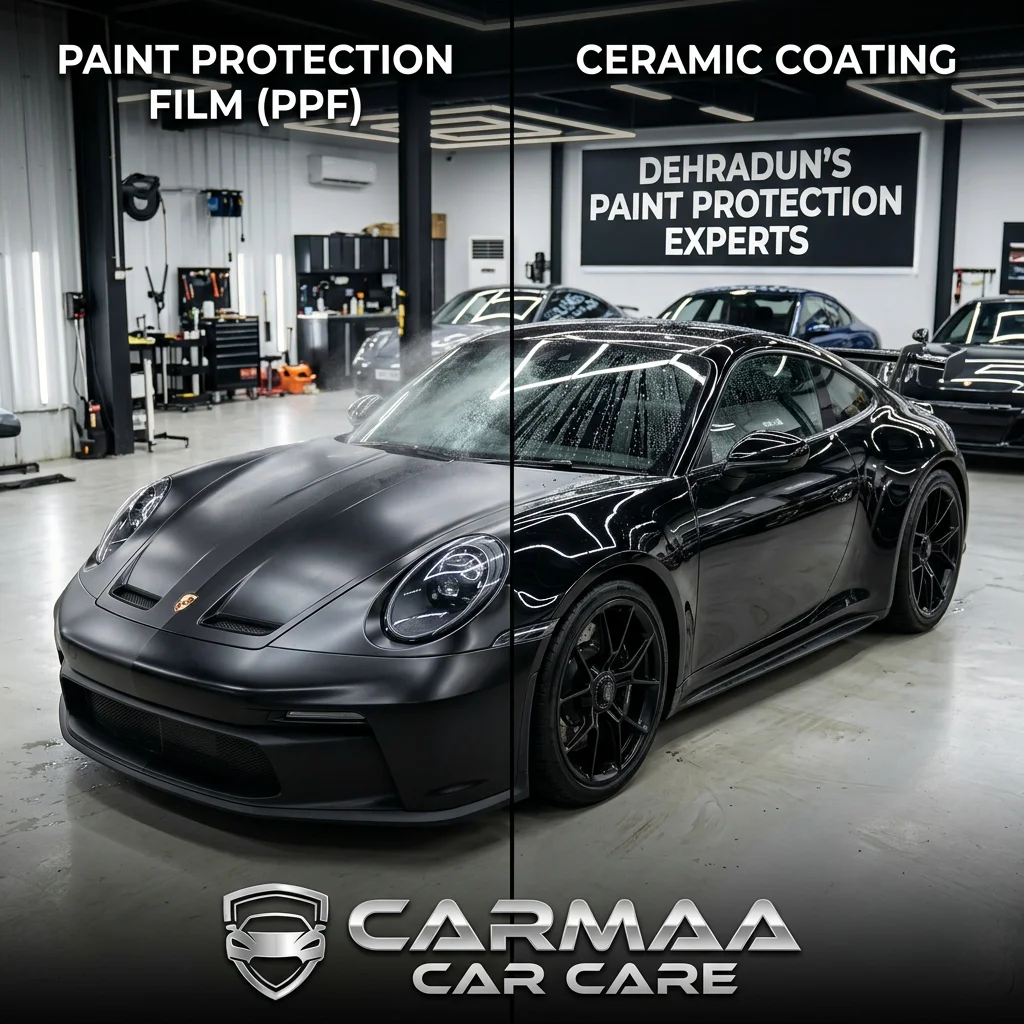
The protection response is the same but the cost-benefit calculation is even more strongly in favour of acting. A professional ceramic coating on an SUV creates a hydrophobic, chemically resistant barrier across that entire large bonnet surface, causing acid rain and mineral deposits to bead and roll off. For SUVs parked outdoors in high-pollution areas like Delhi NCR, Noida, or Faridabad, the graphene coating offers an additional advantage — its heat dispersion properties reduce surface temperature on a dark or metallic-finish SUV bonnet, which directly reduces the concentration effect that causes hard water etching. A full paint correction on a Fortuner or Scorpio costs ₹18,000–₹35,000. A graphene coating costs less and protects for two to three years.
Seven-seater SUVs have a rear section that standard car wash routines completely ignore. The third row seat bases and the rear boot area are the most common sites for monsoon mould in SUVs — and they are almost always found too late, because owners rarely inspect or clean this section until the smell becomes impossible to ignore. Here is what happens: every time the rear door opens, humid monsoon air enters the rear cabin. Third row passengers track mud and wet shoes. Boot contents — wet bags, umbrellas, grocery items — introduce moisture. The AC vents rarely reach the third row with enough airflow to control humidity. Within two to three weeks of monsoon peak, the foam underneath the third row seat squabs is consistently moist.
A professional interior dry cleaning and sanitisation that specifically covers the third row, boot liner, and rear footwells is the correct intervention — not a standard interior vacuum. The dry cleaning process extracts embedded moisture and applies an antimicrobial treatment to the foam substrate. Do this once before the monsoon peaks and once midway through the season for 7-seaters used regularly with rear passengers. Our guide on stopping monsoon mould and humidity in your car's interior covers the full diagnosis and treatment for all cabin areas.
The high ground clearance of an SUV is genuinely useful on flooded and potholed roads — it keeps the exhaust, floor pan, and axles out of standing water that would damage a lower sedan. But there is a trade-off most SUV owners do not consider: at highway speeds, the higher body creates more air turbulence underneath the vehicle, which pulls road spray and contaminated mud upward into wheel arch sections and frame members that a sedan's lower body partially shields. On the Delhi-Meerut Expressway, the Yamuna Expressway, or any busy highway in monsoon rain, an SUV generates significantly more underbody contamination per kilometre than a sedan covering the same route.
This makes a pre-monsoon high-pressure underbody flush and anti-rust coating especially important for SUVs — and especially for SUV owners who use their vehicles the way they were designed to be used, on construction roads in Gurgaon's newer sectors, through Noida Extension's building sites, or on Dehradun's hill road approaches. Mud that enters the frame rail channels and dries there retains moisture against bare metal, and the rust it initiates is structurally invisible until it has progressed to where repair costs tens of thousands of rupees.
The same principle applies as for any car — every four to five days during active monsoon weeks — but an SUV wash needs to consciously cover areas a standard wash misses: the running board channels, the wheel arch inner liners, the roof rail mounting points, and the tailgate lower edge where mud accumulates and is never touched in a standard rinse. Our guide on how often to wash your car during India's monsoon covers the full frequency framework.
For method, the same rule applies as for any vehicle: bucket-and-cloth washing on a dusty SUV drags abrasive particles across the paint surface, creating micro-scratches that compound acid etching damage. A waterless polymer wash encapsulates and lifts contaminants without contact abrasion. The practical advantage for SUV owners is that Carmaa's doorstep service brings the technician and all equipment to your parking — no need to find a car wash facility that can handle an XUV700 or Fortuner, and no risk of the rushed, abrasive washes that are standard at roadside facilities during the busy monsoon season. You can check the 5 most common monsoon washing mistakes Indian car owners make and ensure none apply to your routine.
By October, when the monsoon retreats and owners finally wash their vehicles properly, many SUV owners notice swirl marks — fine circular scratches visible in direct sunlight or under a torch — across the bonnet and roof. These almost always come from the washing method used during the monsoon itself: rough cloths, high-pressure hoses with coarse nozzles at commercial car washes, or abrasive wiping of muddy panels. On an SUV's large flat bonnet, these swirls are more visible than on a sedan's smaller, curved surfaces.
The solution is switching to a quality microfibre-and-polymer wash method before the damage accumulates — not after. If your SUV already has swirl marks from previous seasons, a paint correction service using machine compounding removes them and restores the original gloss. Following paint correction with a ceramic or graphene coating locks in that restored surface and prevents the next monsoon from creating the same damage.
Carmaa's doorstep car care service covers SUVs of all sizes across Delhi, Noida, Gurgaon, Faridabad, Ghaziabad, and Dehradun. Our technicians bring professional-grade waterless wash products, coating application equipment, and interior dry cleaning tools directly to your home or office parking. The service covers everything a standard car wash misses — third row, boot, running board channels, wheel arch liners. For the complete pre-monsoon and mid-monsoon action plan, see our monsoon car care checklist.
Yes. The larger surface area means more total acid rain exposure per event, and the higher ride height creates more underbody spray contamination at highway speeds. The same 4–5 day wash frequency applies, but the wash must cover running boards, wheel arch liners, and rear sections that are easily missed in a standard rinse.
Yes — most commonly through clogged drainage tubes at the sunroof frame corners rather than seal failure. These tubes block with dust and leaf debris during summer and overflow when monsoon rain arrives in volume. Clear them before the rains peak with a thin wire or compressed air, or ask your service centre to flush them. A blocked drain can cause headliner water damage and cabin mould — both expensive repairs.
Strongly yes. The larger bonnet and roof surface area means proportionally greater acid rain and hard water deposit exposure per season. A full paint correction on an XUV700 or Fortuner costs ₹18,000–₹35,000. A professional ceramic or graphene coating costs less, lasts 2–3 years, and prevents that damage from accumulating in the first place.
Get a professional full-cabin dry cleaning and antimicrobial sanitisation that specifically covers the third row and boot — standard car washes never reach these areas. Use a rubber boot liner rather than fabric, keep a silica gel pack in the rear compartment, and make sure any boot drain plugs are clear. If the musty smell has already developed, extraction and antimicrobial treatment is needed — surface sprays do not penetrate the foam substrate where mould roots.
Related Blogs
Pre-Monsoon Car Care Checklist
Top 5 Monsoon Mistakes Car Owners Make
Protect Car Underbody From Monsoon Rust
Stop Monsoon Mould in Your Car Interior
Graphene vs Ceramic Coating — Monsoon Guide
Understanding Car Paint Correction


