It happens so gradually you barely notice. The headlights that were crystal-clear when you bought the car slowly turn milky, then yellow, then almost brown. One rainy night you suddenly realise you can't see the road as well as you used to — and you assume it's your eyes or weak bulbs. Often it isn't either. It's the lens in front of the bulb, and the good news is it can usually be brought back to near-new for a fraction of the cost of replacement.
Modern headlight lenses aren't glass — they're tough, lightweight polycarbonate plastic. From the factory they come with a thin protective film that shields the plastic from ultraviolet light. Under our strong sun, that film slowly breaks down and the polycarbonate underneath starts to oxidise. The result is the familiar yellow, hazy, sometimes crazed look. Road grit, heat and chemical exposure speed it all up, which is why headlights on older or sun-parked cars look the worst.
A clear lens lets your headlight beam pass straight through and land where it should. A yellowed, oxidised lens does the opposite — it scatters and absorbs the light, so less of it reaches the road and the beam pattern goes fuzzy. Studies of degraded headlights have found they can lose a large share of their effective output. You feel it most exactly when it's most dangerous: on an unlit road at night, or driving through monsoon rain where you already need every bit of visibility you can get.
You've probably seen the hack: rub toothpaste on the lens and the haze lifts. It does work a little — toothpaste is a mild abrasive, so it polishes off a thin layer of oxidation. But it only skims the surface, the effect is faint on badly yellowed lenses, and crucially it leaves the bare polycarbonate exposed with no UV protection. Within a few weeks it oxidises again, often worse. It's a quick cosmetic touch-up, not a fix.
A real restoration removes the damaged layer and then re-protects the lens:
• Wet-sanding in stages. Progressively finer abrasives remove the yellowed, oxidised outer layer of polycarbonate without gouging it.
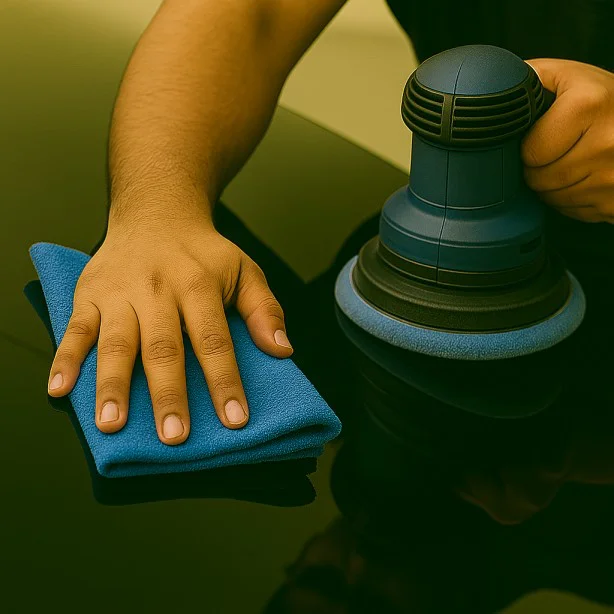
• Machine polishing. A compound and polish on a machine bring the now-clear plastic back to full optical clarity — the same polishing process used to refine paint, which is why detailers do it well.
• Sealing with a UV-resistant coating. A fresh protective coating replaces the factory film so the lens stays clear instead of immediately oxidising again.
This is the difference between a restoration that lasts and one that fails. Sanding and polishing make the lens clear today; the UV-resistant seal is what keeps it that way. Skip it — as most cheap jobs and DIY kits do — and you've simply stripped the plastic bare, so it re-yellows faster than before. A coating that resists UV (the same family of protection as a quality ceramic coating) is what buys you months or years of clarity.
Headlight clarity goes from "nice to have" to "really matters" the moment the monsoon arrives. Wet roads reflect and scatter light, oncoming glare is harsher, and your own dim, yellowed beam leaves you straining to see lane markings and pedestrians. Getting your lenses clear before the heavy rains is one of the simplest safety upgrades you can make — and it pairs naturally with a hydrophobic windscreen and well-kept wipers.
If you have the kit and patience, light yellowing can be tackled at home — just don't skip a proper UV sealant afterwards. For heavily oxidised lenses, the sanding-to-sealing process is exactly the kind of careful polishing work our detailers do every day. With Carmaa, a technician restores and seals your headlights right at your doorstep across Dehradun and Delhi-NCR, usually alongside a polish and wax or full detailing service. See clearly before the next downpour — book a visit today.


